
Fast, governed, or both
Updated: 4 hours ago
What a CEO gets from the technology organization once AI decisions move to the top
AI decisions have moved to the CEO’s desk, and in most companies the technology organization hasn’t moved with them. The result is one of three outcomes: fast and ungoverned, governed and slow, or fast and governed. Only fast and governed holds up at scale, and it depends on one condition: technology leaders who know what the company is trying to do well enough to shape AI decisions before the money is committed. A CEO can test for that condition in a week, and most of the fix is in the CEO’s hands.
AI decisions moved up, and the money moved out of IT
In BCG’s AI Radar 2026, 72 percent of CEOs said they are now the main decision maker on AI in their organizations, twice the share of a year earlier [1]. The spending followed the decisions out of the technology function. BCG’s Applied AI Index 2026 found that corporate AI spending doubled in a year to 3.3 percent of revenue, and that more than 80 percent of it sits outside the enterprise IT budget [2].
Neither shift is a problem by itself. AI changes how sales, operations, and finance work, so business leaders should own those decisions and fund them. The problem is control. The same BCG study found that 42 percent of companies expect to give AI agents real decision-making authority by 2030, while only 5 percent have the full set of controls in place today [2]. Those controls are technology work: data access, security, audit, cost limits, and the ability to roll back. When technology leaders aren’t part of the decision, the controls arrive late or not at all.
The technology organization’s role sets the outcome
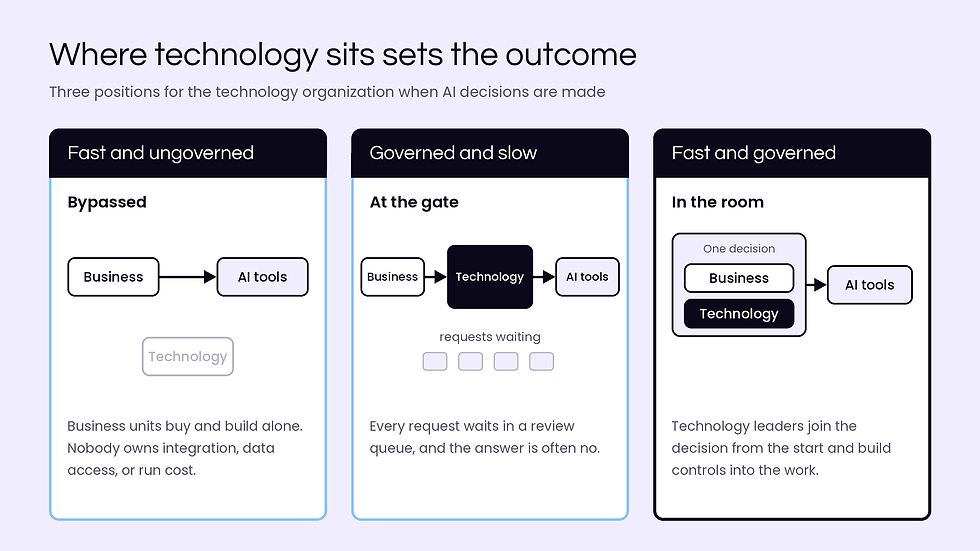
Each outcome follows from where the technology organization sits when AI decisions are made.
Fast and ungoverned. The technology organization is bypassed. Business units buy and build AI on their own budgets, and they move quickly. Nobody owns integration, data access, or run cost, so the company ends up with duplicate tools, agents connected to data they shouldn’t touch, and a cleanup bill that lands on IT a year later.
Governed and slow. The technology organization is the gate. Every AI request waits in a review queue, and the answer is often no, with no alternative attached. Business units learn to route around the gate, which produces fast and ungoverned with added delay.
Fast and governed. Technology leaders sit in the decisions from the start. They propose uses of AI the business hasn’t asked for, and they build controls into the work instead of reviewing it afterward. That depends on knowing the company’s real goals, because a leader who doesn’t know what the company is trying to do can only execute requests or block them.
Technology leaders need the goals behind the mission statement
Most mission statements name values every competitor shares: customers, quality, people. A technology leader who builds to the mission statement builds for a company that doesn’t quite exist. The real goals show up in three places, and the CEO has direct access to all three.
What leaders are paid for. Incentive plans state priorities more plainly than any strategy deck. If the mission statement leads with customer experience and executive bonuses track EBITDA and a sale in three years, the company is preparing for a sale. Its technology choices should favor what a buyer will value. Show technology leaders the plan, and pay them on the measures you’re paid on.
What leaders argue about. The trade-offs that fill executive meetings show what the company is solving for. Put a technology leader in those meetings.
What outsiders say. Customers, competitors, analysts, and recruiters describe the company as it behaves. Where their description and the mission statement disagree, tell technology leaders which one you’re running the company on.
A technology leader with all three can propose AI work that moves the real goal, and can explain a no in terms the business already cares about.
A test you can run in a week
These five checks need no consultant and no survey tool. The first two tell you whether you’re in fast and ungoverned or governed and slow. The last three test whether technology leaders can shape decisions, the condition fast and governed depends on.
Look at the last three AI purchases or projects above a modest threshold. Was a technology leader involved before the money was committed? If not, you’re in fast and ungoverned.
Review the last three times technology said no to a business request. If no alternative came with the no, you’re in governed and slow.
Ask five engineers, chosen at random, what the company is trying to accomplish this year and how their current work moves it. Answers that recite the mission statement, or describe tasks with no business result attached, mean the team can carry out requests but can’t shape them.
Count the proposals your technology organization brought you in the last six months that nobody asked for. If the count is zero, it takes orders and shapes nothing.
Compare your technology leaders’ incentives with your own. If they are paid for uptime and budget variance while you are paid for growth and margin, they are working toward a different goal than you are.
If the first two checks come back clean and the last three pass, you’re in fast and governed.
Moving to fast and governed
From fast and ungoverned, start with an inventory of every AI tool and agent the company runs or pays for, who owns each one, and what data it touches. Then give a technology leader a seat in AI funding decisions, with decision rights over integration, data, and security, and no veto over the business case. Build, buy, or neither covers how to sort what the inventory finds.
From governed and slow, replace the approval queue with published standards: which data AI tools may use, what review AI-generated code needs, and what cost limits apply. A business unit that meets the standards doesn’t wait for approval. Measure the technology organization on time to yes as well as on incidents.
From either starting point, give technology leaders the real goals and pay them on the measures you’re paid on. A technology leader who is paid for what the CEO is paid for, and who knows why, brings proposals instead of waiting for requests.
Questions about where your company sits: dave@dave-nix.com
Notes
[1] Boston Consulting Group, “BCG AI Radar 2026: As AI Investments Surge, CEOs Take the Lead,” survey of 2,360 executives including 640 CEOs; press release January 15, 2026. https://www.bcg.com/press/15january2026-as-ai-investments-surge-ceos-take-lead
[2] Boston Consulting Group, “Applied AI Index 2026,” survey of 1,330 CxOs and senior leaders; press release September 30, 2026. https://www.bcg.com/press/30september2026-ai-starting-to-pay-off-companies-generate-value
© 2026 David Nix. Licensed under CC BY-NC-ND 4.0.

